

Xebi
Or one important thing that I learnt from my Chiric Sanango dieta

There are two kinds of fools: one says, “This is old, therefore it is good”; the other says, “This is new, therefore it is better.”
—William Ralph Inge, More Lay Thoughts of a Dean (1931:200).
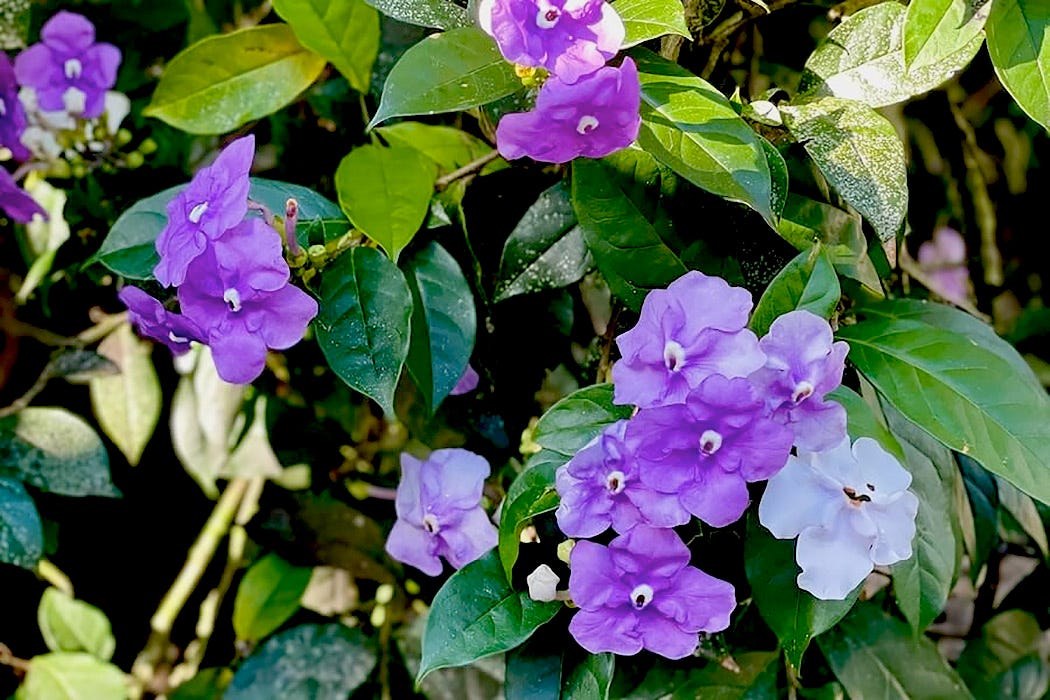
One of the most powerful dietas that I did in the jungle was a month-long ordeal with the chiric sanango, (Brunfelsia grandiflora), a beautiful tree with evergreen white and purple flowers.
For a period of time after my dieta, I would try and nurture my relationship with the chiric by regularly visiting a couple of trees that were found on the Sanctuary’s grounds. I would walk past the trees, and pick up the fallen flowers from the ground, gather them and take them with me to place on the table, in my pockets or under my pillow.
Nobody told me to do that, it’s just something that I did. People do all sorts of weird and creative things when determined to connect and learn from a plant.
One day as I was loitering around a chiric sanango tree that thrived along the path leading from the maloka to the dining room, I noticed that one of the older Shipibo women was walking towards me. Her name is Maricela, and she’s an onanya: she knows how to heal and learn from the plants.
In that moment, I didn’t quite know Maricela all that well; she had arrived to the center very recently, and she appeared to be rather quiet and reserved. She seemed to be more serious than most of my other colleagues. In fact, I don’t think that I had ever talked to her yet, just the two of us.
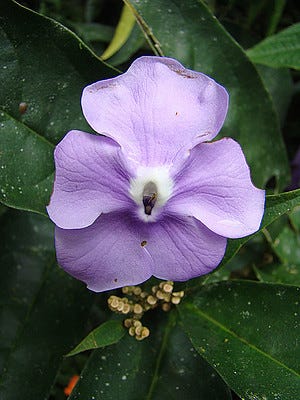
Now, the chiric flowers are beautiful, and they are also, it turns out, peculiarly shaped. Brunfelsia flowers are pentamerous— each composed of five broad petals.
Right in the middle of the flat petals that compose its corolla, there’s a little bump with a little hole —the stigma, which is the outermost part of the pistil, the female reproductive part of the flower.
Anyway, I’m not here to tell you about floral morphology, of which I know very little, but to share with you the very first thing that Maricela ever said to me.
Besides being very beautiful (purple is my favorite color), chiric flowers are also very fragrant. They smell really nice. So whenever I was picking up the stray, still fresh flowers scattered on the ground, I enjoyed smelling them too, because that’s what you do when you are holding a fragrant flower in your hand. Right?
So there I am, standing under the shade of the chiric shrub, smelling the fragrant chiric flower, when Maricela stops right in front of me, without a second of hesitation, and very confidently proceeds to pluck another fresh chiric flower for herself.
Looking at my eyes intensely, she gestured to make me understand that she wanted to tell me something, but I needed to come closer, which for me means bending my knees quite significantly so I can bring myself to Maricela’s height (my Shipibo colleagues had many names and nicknames for me, one of which was simply ani joni, “tall man”)
Once level with Maricela, eye to eye, standing very close to each other, Maricela brought the flower right in front of my eyes, as if she wanted me to look at the flower very attentively, before she shared her wisdom with me.
Silence.
Tension.
At this point I was elated, thinking, “she is going to teach me something important, maybe something related to my dieta with the chiric, maybe she saw something or felt something related to me in a vision, and came all the way here to find me and tell it to me.”
Maybe I was feeling a little too self-important, as many of us foreign dieteros tend to feel, about to be given a rare initiation by a quiet and reserved onanya whom I didn’t quite know. Maybe she had an important piece of the puzzle for my personal and bespoke healing journey.
And right then, as I was looking at the flower, eager to hear what maestra Maricela wanted to share with me, she lifted the flower a little higher, and, with her other hand, pointed to the middle of the flower, right were the opening of the pistil was.
She looked at me, to make sure that I was looking at what she wanted me to look at, and with her finger, she tapped at the center of the flower, which I now realized looked very much feminine, and with a mischievous spark in her eye and half a smile she leaned over towards my ear and said softly:
“xebi”.
“xebi?”, I repeated, confused.
“xebi!’, she repeated out loud, laughing as she turned her back to me and walked away, without looking back, leaving me somewhat humbled and disoriented, moving on with her day.
And that’s how I learnt the Shipibo word for “vagina”.
Really appreciate this. A beautifully crafted gem 🌸